


Transform 2030
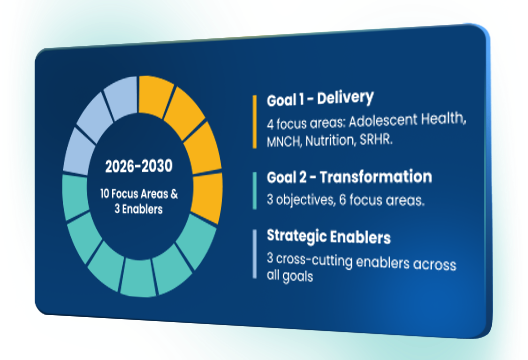
These focus areas are not silos. The GFF supports a continuum of care from adolescence through pregnancy, birth and early childhood, with nutrition and sexual and reproductive health and rights integrated into primary health care and MNCH services.

Adolescent Health
Many GFF partner countries have the largest youth generation in their history, a unique opportunity to invest in their health. Adolescent birth rates are falling, and progress can be sped up where rates are highest. Measuring adolescent's use of preventive services alongside birth outcomes would help countries see earlier what is working.
TRANSFORM 2030 commits the GFF to adolescent-responsive services, HPV vaccination and adolescent nutrition, and to leading the IDA21 commitment on sexual and reproductive health.

Maternal, Newborn and Child Health (MNCH)
35 of 36 GFF partner countries have reduced maternal and child mortality since 2015. Progress is still too slow to reach the 2030 targets, and the gap between the poorest and wealthiest families shows how many of these deaths can be prevented with care that already exists.
GFF vision for 2026–2030: no women, children, or adolescents die from preventable causes.

Nutrition
Malnutrition is linked to nearly half of all deaths among children under five. Stunting is falling in most GFF Partner countries, but slowly, and wasting has barely moved. Nutrition remains the largest share of GFF country investments under the 2026–2030 strategy.
The GFF met its target of committing up to 30% of country investments to nutrition and will hold that share through 2030.

Sexual and Reproductive Health and Rights
Family planning could prevent about 30% of maternal deaths. GFF Partner countries are expanding modern contraceptive use faster than comparable countries, and adolescent births are falling everywhere, though too slowly where rates are highest.
TRANSFORM 2030 commits the GFF to expanding access to SRHR and choice for women and adolescent girls, and to leading implementation of the IDA21 commitment on sexual and reproductive health services.
Three strategic objectives, each with its own focus areas.
Mobilize more and smarter country-led health financing for integrated PHC systems

Health Financing
Since the inception of the GFF, supporting health financing reforms has been a critical part of its mission. The core objectives of the GFF's health financing agenda are to increase both, the volume and efficiency of domestic public resources for health.

IDA Investments in RMNCAH-N
Working closely with country partners and World Bank task teams to use data to allocate IDA toward the highest impact interventions for women, children and adolescents is a key part of the theory of change of the Global Financing Facility for Women, Children, and Adolescents (GFF). The GFF therefore conducts regular analyses to monitor changes in International Development Assistance (IDA) commitments to Reproductive, Maternal, Newborn, Child, and Adolescent Health and Nutrition (RMNCAH-N) across its supported countries.
Accelerate progress by improving quality of service delivery and scaling access to commodities

Commodities
Strengthening access to lifesaving health commodities, including the S-CAP program.

PHC Service Quality Readliness
Facility infrastructure, service availability and quality of care.
Foster health system sustainability, sovereignty and resilience

FASTR: The GFF’s Initiative for Rapid Cycle Analytics and Data Use
Strengthening PHC systems and improving RMNCAH-N outcomes through timely and high-frequency analysis and use of data

Health Workforce
Community health workers and midwives as an engine of resilient PHC.
Cross-cutting areas that support every goal and objective of the strategy.
Integrating gender and equity across the GFF portfolio


Optimizing collaboration with the WBG and global and regional partners

AdLAB – Adolescent Learning, Action, and Benchmarking
Learning how to implement what works to help adolescents thrive!
For questions or collaboration inquiries, please contact the AdLAB team at adlab [at] worldbank.org (adlab[at]worldbank[dot]org)

Monitoring and Action for Gender and Equity (MAGE)
Stay tuned: More MAGE resources are coming soon as part of the GFF's TRANSFORM 2030 strategy.

Partnership with Countdown to 2030
Aligned action with countries, donors and technical partners.

PHC Collaborative Data Hub
Primary Health Care (PHC) is the cornerstone of health systems, helping ensure health care is universally accessible, improving quality of life, and reducing health inequalities.
Strengthening results measurement and ongoing learning and innovation

FASTR Resources and Data Repository
Guidance, tools and data for rapid cycle analytics.

GFF Data Download Module
Download portal indicators and datasets.

PHC Data Repository
PHC population and facility indicators for download.

Results Framework 2026 to 2030
Indicators and targets for the TRANSFORM 2030 strategy.