

Supporting PHC systems monitoring via timely, rapid-cycle health facility phone surveys
What are rapid-cycle health facility phone surveys?
Effective PHC systems are critical to scaling up high-impact interventions to improve RMNCAH-N outcomes. Rapid-cycle longitudinal health surveys, implemented via computer-assisted telephone interviewing (CATI), are conducted with health care facilities establish an ongoing monitoring platform, enabling countries to:
- Continuously evaluate PHC readiness and identify obstacles to delivering high quality care, with feedback loops to inform strengthening actions at multiple levels.
- Keep a close watch on the implementation of health care reforms, providing the needed insights to course correct or scale-up implementation.
- Capture the effects of unexpected events – such as epidemics, natural disasters, or violence – on the health system, allowing for the measurement of the PHC system’s resilience in near-real time.
- Track changes in health system performance over time.
How does it work?
Through collaborative efforts with Ministries of Health and national survey organizations, the GFF supports countries in developing a flexible health facility phone survey platform that can adapt to evolving health system dynamics. This allows countries to utilize phone surveys as a monitoring mechanism in between traditional, in-person assessments that occur less frequently.
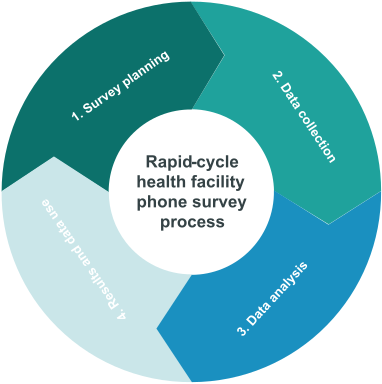
Figure. Steps to implement rapid-cycle surveys
Tools and Resources
Survey Planning
Survey planning begins with early engagement with government stakeholders to ensure that the survey accurately reflects national priorities and data needs. During this stage, the FASTR survey team will work with stakeholders to identify data use cases, how the data will be used, and which data needs are most important. These discussions can also help determine when survey findings will be most useful for policy, program, and resource allocation decisions. The planning process will also establish whether it is feasible to carry out the survey as designed. This includes confirming that a complete and current sampling frame is available, with accurate and reliable contact details for facilities, and assessing whether mobile network coverage is adequate for phone-based data collection. Last, stakeholders should determine whether ethical review is required. If it is, the appropriate review board should be identified and submission materials prepared promptly, since the review and approval process can take several months.
Data Collection
FASTR rapid-cycle health facility phone survey tool
The FASTR rapid-cycle health facility phone survey tool has been designed to monitor service availability, readiness, and functioning of PHC facilities over time, with an emphasis on the needs of women, children, and adolescents. The measurement approach is grounded in the Primary Health Care Measurement Framework and Indicators (PHC MFI), developed by the World Health Organization and UNICEF, and the indicators are aligned to and complementary with existing in-person comprehensive health facility assessments (such as the Harmonized Health Facility Assessment ,Service Availability and Readiness Assessment , Service Delivery Indicators survey , and the Service Provision Assessment ).
The rapid-cycle nature of the survey is particularly well suited to monitor the implementation of interventions and to capture the effect of shocks on PHC functioning in a timely and ongoing manner. The base survey tool includes 10 core modules, 3 of which are repeated on a quarterly basis, whereas the 7 remaining modules are implemented annually during one survey round. These include: infrastructure, financing, service availability, shocks, resilience to shocks, workforce and staffing, supplies, leadership and coordination, community engagement, and quality improvement processes. Service-specific modules for antenatal care, immunization, and intrapartum care are also available for countries that wish to deepen their understanding of delivery of these services with one dedicated survey round.
This survey is designed to enhance the timeliness and adaptive nature of health facility surveys by complementing existing, large-scale in-person surveys with a rapid-cycle, phone-based approach. The base survey tool and its additional service-specific modules are designed to be implemented over four or more quarterly rounds of data collection with a panel sample of PHC facilities. The core survey questionnaire and its accompanying service-specific modules are the starting point for country adaptation.
- [FASTR rapid-cycle health facility phone survey base tool, English, docx]
- [FASTR rapid-cycle health facility phone survey base tool, French, docx]
- [FASTR rapid-cycle health facility phone survey base tool, programmed, English and French, xlsx]
Data Analysis
Data analysis is conducted for each round of surveys on a set of quarterly indicators asked every round and annual indicators asked in one round only. The core questionnaire indicators and analysis plan are the starting point for country adaptation.
Results and Data Use
Supporting continuous monitoring of PHC performance
FASTR supports countries to generate, analyze, and use rapid-cycle health facility survey data for decision making. FASTR currently implements the facility phone surveys in over 20 countries; In Burkina Faso and Vietnam, rapid-cycle health facility phone surveys have supported Ministries of Health and other stakeholders to capture the impact of shocks on PHC service delivery, track the availability in medicines and vaccines, and gain insights on community engagement and bypassing to the private sector. In Senegal and Madagascar, survey results are also enabling the Ministries of Health to provide timely quality improvement feedback to districts and health facilities.
- Rapport: Resultats d’enquete, Republique de Madagascar, Troisieme cycle, 2025
- Rapport: Resultats d’enquete, Republique de Madagascar, Deuxieme cycle, 2024
- Rapport: RÉSULTATS DE L’ENQUÊTE, République de Madagascar, Premier cycle, 2024.
- Rapport: Enquete telephonique a cycle rapide aupres des formations sanitaires FASTR Senegal: Premier passage, Mars-Avril 2024
- Report: Rapid Health Facility Assessment, Vietnam, December 2023
More reports and available datasets are in the FASTR Resource Repository – click here.
Validation and learning agenda for health facility phone surveys
Through FASTR, the GFF is investing in an ongoing validation and learning agenda to test and validate a variety of RMNCAH-N and PHC data collection and analysis approaches that offer different advantages in terms of timeliness, precision, and resources.
Practical, 'learning-by-doing' approaches such as in-person spot checks provide iterative opportunities to improve the precision of phone-based data collection.
Since 2024, the GFF and the World Bank have implemented several rapid and large-scale validation studies of the FASTR health facility phone survey instrument.
Nimble validation studies conducted alongside FASTR implementation have shown promising results. In Ghana, for example, a recent validation study found no statistically significant differences in average availability of infrastructure and medical supplies, between phone and in-person surveys. Similarly, In Senegal, a recent spot check exercise highlighted strong consistency between phone and in-person data collection for key medicines and infrastructure indicators and emphasized the importance of simplification of some infrastructure indicators for phone-based measurement.
- Report: Leveraging Rapid-Cycle Phone Surveys for Improved Measurement of Primary Health Care Services: Insights from a health facility phone survey validation study in the Western and Volta regions, Ghana
- Brief: Comparison of Results of the FASTR Health Facility Phone Survey to an In-Person Spot Check Visit in Senegal
The GFF and World Bank have also supported several large-scale validation studies. The first of these is a side-by-side validation of the FASTR rapid-cycle health facility phone survey against the in-person Service Delivery Indicators survey in Tajikistan. Results are expected to be available at the end of 2026.
More reports and available datasets are in the FASTR Resource Repository – click here.
Assessing PHC resiliency to provide RMNCAH-N services during the COVID-19 pandemic
The GFF supported high-frequency health facility phone surveys in Bangladesh, Burkina Faso, Chad, Guatemala, Guinea, Liberia, Malawi and Nigeria during the height of the COVID-19 pandemic in 2020 to 2021. This data assessed primary health care facilities’ resilience to the pandemic and their ability to maintain essential RMNCAH-N services for populations. Findings supported Essential Health Services Grants provided by the GFF to partner countries.