

Supporting countries to strengthen primary health care (PHC) systems and improving RMNCAH-N outcomes through the timely and high-frequency analysis and use of routine health management information systems data.
What is RMNCAH-N Service Use Monitoring?
Rapid-cycle approaches using routine health management information system (HMIS) data can be used to:
- Evaluate the quality of HMIS data both at the national and sub-national levels to help address gaps in quality and completeness.
- Measure monthly changes in the utilization of critical health services, enabling a rapid response to challenges and the opportunity to gain insights on the progress of reforms.
- Compare service coverage trends with country targets, facilitating the continuous monitoring of RMNCAH-N progress.
How does it work?
Through collaboration with Ministries of Health, the GFF assists countries in developing and reviewing regular analyses of HMIS data, focusing on specific priority health service indicators linked to national health care reforms, as well as GFF and World Bank investments. The findings derived from these analyses are translated into actionable strategies through the country's planning processes and are integrated into the project cycles of the GFF and the World Bank.
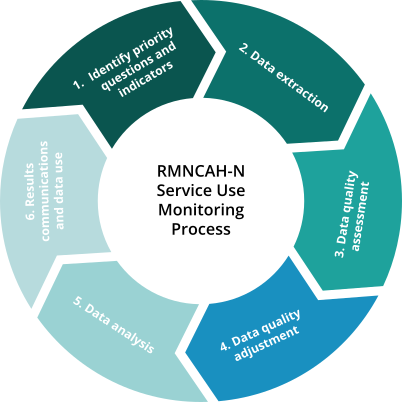
Figure. Steps to implement RMNCAH-N service use monitoring
Tools and Resources
Identify Priority Questions and Indicators
Before extracting and analyzing routine HMIS data, country teams work to define a clear use case — the priority policy questions, key indicators, and stakeholders that will anchor the RMNCAH-N service use analysis. This includes an early feasibility check on candidate indicators: confirming they are available in DHIS2 (or another routine system), clearly defined, and reported with sufficient volume, completeness, and frequency to support rapid-cycle analysis.
Tool: FASTR Data Preparation Checklist — a step-by-step checklist for aligning indicators with national policy priorities, mapping them to DHIS2 data elements, and assessing data quality and feasibility before extraction.
Data Extraction
FASTR supports two approaches to extract and import HMIS data from DHIS2:
Direct import into FASTRData can be imported automatically from DHIS2 to the FASTR platform by connecting to a DHIS2 instance and importing the data needed for analysis. The direct import process and configuration requirements are described in the next section.
DHIS2 Data DownloaderThe DHIS2 Data Downloader is a desktop application that connects to a DHIS2 instance and allows users to select dimensions, periods, organization units, and organization levels before downloading the corresponding data. The tool may be used for countries opting for manual data import, or where bulk data extraction is required for other purposes.
Additional features include:
- HMIS data dictionary — search for relevant terms to retrieve the 11-character JSON ID for data elements, indicators, and category combos; converts JSON IDs to readable indicator names when numerator and denominator data elements are available.
- Facility information access — a facility table listing all health facilities registered in the DHIS2 system with key attributes, exportable as CSV, plus a facility map view showing all facilities with GPS coordinates.
- Download the DHIS2 Data Downloader Tool here
- Installation instructions
Data Quality Assessment, Data Quality Adjustment, Data Analysis
Data quality assessment, data quality adjustment, and analysis are now all conducted within the FASTR Analytics Platform. Countries import their routine HMIS data, and the platform runs the full FASTR analysis pipeline automatically — assessing completeness, outliers, and consistency; adjusting for data quality issues so trends reflect actual service delivery rather than reporting artefacts; and generating service utilization and coverage estimates. Results can be explored as charts, maps, and tables, or assembled into slide decks and reports for decision-makers.
The platform includes a built-in AI assistant that helps users interpret results and draft narrative text directly alongside the figures — turning a completed analysis into decision-ready output without a specialist analyst or a separate write-up step. This lets country teams generate customized reports themselves, with quality-improved indicators, in a fraction of the time it would take with a manual, analyst-led process. The combination of a straightforward interface and the AI assistant allows decision-makers to generate complex statistical analyses themselves, reducing reliance on external consultants and keeping the analysis in the hands of country teams.
- Platform documentation: fastr-analytics.org — includes an overview, admin guide, and user guide for setting up an instance, running the analyses, and sharing results, along with video tutorials walking through the platform's features.
- Methodology: the full FASTR analytical methodology — covering data quality dimensions, adjustment techniques, service utilization analysis, and coverage estimation — is documented in detail at fastr-analytics.org/methodology.
- Try it: a sandbox version of the platform is available for exploring the AI-assisted analysis and reporting features firsthand.
Results Communication and Data Use
GFF partner countries have adopted FASTR's approach to routine HMIS analysis, across a range of use cases:
- Feeding into official M&E processes: FASTR findings are being formally integrated into Joint Annual Reviews, quarterly performance dialogues, and national M&E coordination platforms — replacing or supplementing infrequent periodic surveys with a continuous, real-time evidence base for tracking RMNCAH-N performance and service readiness.
- Prompting direct government action: In several countries, ministry leadership has instructed regional or district teams to review FASTR findings and take follow-up action — using the results to spotlight service gaps, target investments, and steer priority-setting discussions at the subnational level.
- Feeding into World Bank/GFF project monitoring: FASTR results are being used to formally monitor the implementation of World Bank/GFF co-financed projects, giving task teams a regular, structured evidence base between formal project review points. This includes tracking the progress of major national reforms and performance-based financing programs that these projects support.
- Strengthening subnational implementation: Countries are extending FASTR beyond the national level, cascading training on data extraction, interpretation, and use to management and M&E staff at the district level, and embedding FASTR as a standard part of subnational review processes — building the capacity to generate and act on rapid-cycle evidence closer to where services are delivered.
- Blog: From data collection to data use: How Ghana and Nigeria are strengthening health systems through rapid-cycle analytics
- Blog: How AI is helping countries analyze health data in hours, not weeks
During the COVID-19 pandemic, the GFF supported Ministries of Health in over 20 countries to monitor the impact of the pandemic on essential health services.
- Blog: COVID-19: Impact on Essential Health Services
- Blog: Healthcare utilization and maternal and child mortality during the COVID-19 pandemic in 18 low- and middle-income countries
- Article: Vaccination utilization and subnational inequities during the COVID-19 pandemic
- Article: Disruptions in maternal and child health service utilization during COVID-19: analysis from eight sub-Saharan African countries
More results and reports can be found in the FASTR Resource Repository – click here.